Specific Calorie, Fitness & Nutrition Calculators
Jump directly to specialized fitness, metabolism, and body composition calculators:
Calculate baseline calories burned strictly at rest via the clinical Mifflin-St Jeor formula.
Determine total daily calories burned with lifestyle movement and exercise multipliers.
Target daily protein, carbohydrate, and fat gram ratios for muscle growth or fat loss.
Optimal daily grams of dietary protein customized by body weight and workout frequency.
Safe, sustainable fat loss targets (300-500 kcal deficit) to preserve lean muscle mass.
Estimate fat mass and lean muscle percentage using neck, waist, and hip measurements.
Clinical healthy weight target based on height and biological sex.
Calculate optimal daily fluid volume in liters and ounces customized for workout activity.
Schedule eating and fasting windows for 16:8, 18:6, 20:4, and OMAD protocols.
Understanding TDEE, BMR & Daily Calorie Needs
Total Daily Energy Expenditure (TDEE) represents the total number of calories your body burns in 24 hours, accounting for your age, gender, height, weight, and physical activity level. Knowing your TDEE is the starting point for any evidence-based nutrition plan — whether you want to lose fat, build muscle, or maintain your current weight.
This calculator uses the Mifflin-St Jeor equation, the formula recommended by the Academy of Nutrition and Dietetics as the most accurate standard BMR model for non-athletic adults. Your BMR is then multiplied by an activity factor to produce your TDEE.
Activity Level Multipliers
- Sedentary (×1.2): Desk job, little or no deliberate exercise.
- Lightly active (×1.375): Light exercise or sports 1–3 days per week.
- Moderately active (×1.55): Moderate exercise 3–5 days per week.
- Very active (×1.725): Hard exercise 6–7 days per week.
- Extra active (×1.9): Physical job + daily intense training.
Macro Ratio Split Strategies
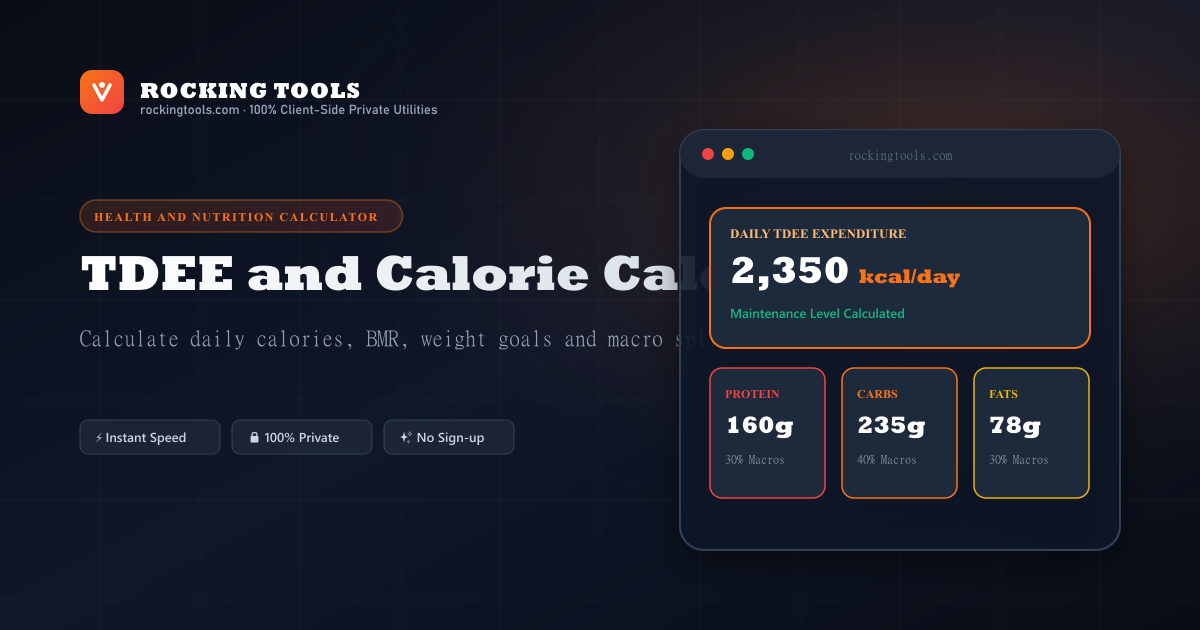
- Balanced (30/40/30): 30% Protein, 40% Carbs, 30% Fat — ideal for maintenance and general fitness.
- High Protein (40/30/30): 40% Protein, 30% Carbs, 30% Fat — supports muscle preservation during weight loss.
- Low Carb (40/20/40): 40% Protein, 20% Carbs, 40% Fat — suitable for carbohydrate sensitivity or keto-adjacent diets.
Frequently Asked Questions
What is BMR vs TDEE?
BMR (Basal Metabolic Rate) is the number of calories your body burns at complete rest to maintain vital functions. TDEE (Total Daily Energy Expenditure) adds your physical activity and exercise multiplier on top of BMR — it is the real-world calories you burn daily.
Which formula is used for calorie estimation?
This calculator uses the Mifflin-St Jeor equation, widely validated as the most accurate BMR formula for the general population. For males: BMR = (10 × weight kg) + (6.25 × height cm) − (5 × age) + 5. For females: the same formula but −161 instead of +5.
How do I adjust calories for weight loss or muscle gain?
For weight loss, create a 300–500 calorie deficit below TDEE — this produces roughly 0.3–0.5 kg of fat loss per week. For muscle gain (lean bulk), eat 200–300 calories above TDEE. Avoid deficits larger than 1000 kcal/day as they cause muscle loss.
What is a macro split and how do I pick one?
A macro split defines the percentage of calories from protein, carbohydrates, and fat. A standard balanced split is 30% protein / 40% carbs / 30% fat. High-protein (40/30/30) is ideal for weight loss or muscle building. Low-carb (40/20/40) suits those with carbohydrate sensitivity or insulin resistance.
How many calories should I eat to lose 1 kg per week?
One kilogram of body fat is approximately 7700 calories. To lose 1 kg per week you need a daily deficit of ~1100 kcal, which is aggressive and not recommended for most people. A safer pace is 0.5 kg per week (550 kcal deficit). Always keep intake above 1200 kcal (women) or 1500 kcal (men) to prevent nutrient deficiency.
Is my health data stored or shared?
No. All calculations happen entirely in your browser using JavaScript. No health data — age, weight, height, gender, or activity level — is transmitted to any server. Your information never leaves your device.
How accurate is this calorie calculator?
The Mifflin-St Jeor equation is accurate within ±10% for most adults. Results are estimates — individual metabolism varies based on genetics, muscle mass, hormones, and lifestyle. Use the result as a starting point and adjust based on 2–3 weeks of real-world tracking.