Password Security, Entropy & Crack Time Analysis
Understanding why passwords fail is the first step to securing your accounts. Most breaches do not happen through Hollywood-style hacking — they happen because attackers have access to billions of previously leaked passwords and test them against new accounts in seconds using automated tools.
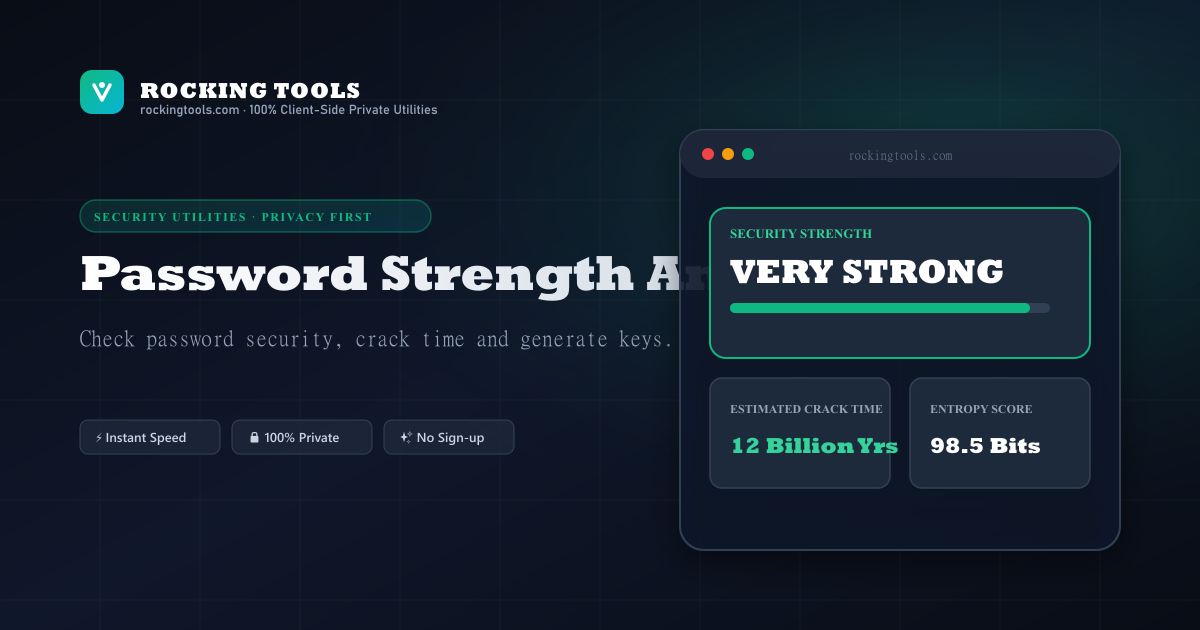
This checker analyzes your password's character set variety, length, pattern predictability, and entropy in bits to estimate how long a modern GPU-based brute-force attack would take to crack it.
Best Practices for Password Security
- Length Over Complexity: A 20-character passphrase of random words is significantly stronger than an 8-character complex string.
- Use a Password Manager: Generate and store unique, high-entropy passwords for every account. Never reuse passwords across sites.
- Enable Multi-Factor Authentication (MFA): Hardware keys or authenticator apps protect accounts even if passwords leak in a data breach.
- Avoid Personal Information: Birthdates, names, and dictionary words are always tested first by attackers.
- Check Breach Databases: Services like HaveIBeenPwned let you check if your email appeared in known data breaches.
Dedicated Password & Security Utilities
Jump directly to specialized password generation and testing tools:
Generate high-entropy random passwords with mixed cases, numbers, and symbols.
Generate military-grade 24-character master keys for root servers and password vaults.
Generate unpredictable numeric PIN codes for ATM cards, phone locks, and keypads.
Create easy-to-remember multi-word passphrases (e.g. correct-horse-battery-staple).
Test password entropy and calculate real-time GPU cluster crack duration estimates.
Frequently Asked Questions
Is it safe to type my real password here?
Yes. All password strength calculations, entropy analysis, and random generation occur strictly in local client JavaScript. Zero network requests are made — your password never leaves your device. You can verify this by going offline before using the tool.
How is password entropy calculated?
Password entropy (in bits) measures how unpredictable your password is. It is calculated as: Entropy = log2(charset size ^ length). A 12-character password using all character types has a charset of ~95 characters, giving ~78 bits of entropy — considered very strong against brute-force attacks.
What makes a password strong against brute-force attacks?
Passphrases or passwords with 16+ characters combining random words or mixed character sets (lowercase, uppercase, digits, symbols) take centuries to crack even with modern GPU hardware. Length is the single most important factor.
What is the difference between a dictionary attack and a brute-force attack?
A dictionary attack tries common words, phrases, and known leaked passwords from breach databases. A brute-force attack systematically tries every possible combination. Most attackers start with dictionary attacks because the majority of user passwords are predictable.
How long should a secure password be?
Security experts recommend a minimum of 12 characters for regular accounts and 16+ characters for sensitive accounts (banking, email, cloud storage). Using a password manager lets you use 20+ character random passwords without memorizing them.
What is a cryptographically secure random password?
The generator uses your browser's built-in Web Crypto API (window.crypto.getRandomValues) which produces true cryptographic randomness — the same source used by SSL certificates. This is far more secure than Math.random() which is not cryptographically safe.